Published
11 minute read
Miami is very good at selling the image of effortlessness. Flat stomach, clean jawline, expensive hair, no visible recovery period, no bad angles, no buyer’s remorse. Aesthetic medicine fits neatly into that fantasy, which is exactly why patients need to be more skeptical here than almost anywhere else.
Because in Miami, the problem is rarely a lack of options. The problem is overproduction.
Every medspa has a beautiful website. Every injector has a tidy grid. Every before-and-after looks like it was shot on the one forgiving day in South Florida when the light behaved. The reviews gush. The skin glows. The lips are “natural.” The cheek filler is “subtle.” Everyone online appears to have made one impeccable decision after another.
That is not how real aesthetic medicine looks.
At Miami Skin + Vein, we see patients after the scroll. After the saved posts. After the friend's recommendation that somehow came packaged with a discount code and a ring light. They come in thinking they are choosing between great providers. Often, they are really choosing between great marketing systems.
Those are not the same thing.
A polished practice is not necessarily a dishonest one. Let’s start there.
Good branding can signal care. Good photography can be useful. A clear website is a courtesy. No serious person is arguing that aesthetic practices should market themselves with clip-art and broken links.
The problem starts when the marketing becomes more convincing than the medicine.
That happens all the time in aesthetics because this is one of the few medical categories where patients are expected to make a clinical decision inside a lifestyle fantasy. You are not just being sold a treatment. You are being sold a future version of your face, your schedule, your dating life, your mirror. That makes people unusually vulnerable to polished language and overproduced proof.
And Miami, with its camera-conscious social culture and relentless beauty economy, is a place where that pressure gets amplified.
Patients often assume bad aesthetic marketing will look obvious. It usually doesn’t.
It does not always shout. Sometimes it smiles politely and hands you a very clean promise.
Misleading marketing in this field tends to work by removing friction. It leaves out the bruising. It smooths over the swelling. It talks about “refreshing” the face without explaining what is actually being injected, where, in what amount, and why. It shows outcomes as if they were standard, when they may be the best result from the best anatomy under the best lighting on the best day.
That kind of marketing is not always technically false. It is often strategically incomplete.
Patients feel the difference later.
People want to believe in photos. That makes sense. Aesthetic medicine is visual. The eye wants receipts.
But before-and-after galleries are one of the easiest places to manipulate perception without ever opening Photoshop. Different lighting. Different camera distances. Chin slightly lifted. Better posture. Less redness. More gloss on the lips. A softer lens. Better timing. A result captured at its peak, then quietly presented as the norm.
None of that is accidental.
The strongest galleries usually look less dramatic, which is part of why less experienced patients misread them. Honest photography is often a little boring. Same angle. Same expression. Same lighting. No theatrical contrast. No sudden transformation into a different species of woman.
And that matters. Especially with Botox, filler, and skin treatments, where the most elegant work usually reads better in person than it does in a high-sharpened square on Instagram.
A provider whose entire gallery looks “wow” may be telling you less than a provider whose work looks consistently believable.
This part is less mysterious than people think.
Real reviews have texture. People mention the way the consultation felt. Whether they were rushed. Whether the injector talked them out of something. Whether the bruising was explained honestly. Whether the staff was calm, cold, warm, organized, late, attentive. Real experiences leave residue.
Manufactured reviews tend to read like brand supervision. Same tone. Same pacing. Same vague ecstasy. Everything is “amazing.” Everyone is “so knowledgeable.” Results are “perfect.” The office is “beautiful.” It starts to sound less like patient feedback and more like someone trying to protect a conversion funnel.
That does not mean every glowing review is fake. It means patients should read them like adults.
If twenty people supposedly had life-changing treatment and none of them can describe anything specific, something is off.
A few phrases in aesthetics are used more often. Few mean less on their own.
“Natural” can describe tasteful work. It can also describe under-treatment, over-marketed filler, or a provider skilled enough to make visible intervention sound invisible. The word is so overused that patients now hear it as reassurance before they hear it as description.
A better question is this: natural according to whom?
Natural on camera is different from natural at brunch. Natural in a still photo is different from natural when someone laughs, squints, talks, or turns their head. Some results are built for social media. Some are built for life. Those categories overlap less than the industry likes to admit.
A good provider should be able to explain the difference without hiding behind a slogan.
This is where aesthetics gets emotionally expensive.
A patient can receive appropriate treatment, heal normally, and still feel let down. Not because the injector did poor work. Because the expectation was inflated at the beginning by images and language that suggested a more dramatic endpoint than their own anatomy could reasonably deliver.
That gap is brutal. And common.
In real life, outcomes are shaped by bone structure, skin quality, age, movement patterns, scar history, sun damage, swelling, healing, and restraint. Online, those variables disappear. The face becomes a marketing surface. The treatment becomes a shortcut. The result becomes a promise.
Then the patient meets the mirror.
It is hard to overstate how much disappointment in aesthetics begins with messaging, not medicine.
That is one of the more inconvenient truths in this category.
Good providers are often less thrilling in consultation. They talk more about limitations. They hedge where hedging is appropriate. They explain why something may help but not fully solve the issue. They mention maintenance. They mention tradeoffs. They may even suggest waiting.
That can feel less exciting than the provider who says yes to everything. It is also usually a better sign.
An honest consultation should not feel like a performance of certainty. It should feel like someone with medical judgment is thinking in real time about your face, your tissue, your goals, your tolerance for downtime, and your tendency to regret impulsive decisions.
Some restraint is a gift.
A provider who tells every patient they are the perfect candidate is not being flattering. They are being useful to their own sales process.
The same goes for hard urgency. Limited-time filler packages. Same-day pressure. Add-ons that appear before a diagnosis-level conversation has even happened. Promise-heavy language with very little anatomical specificity. Minimal discussion of risk. Minimal discussion of what happens if the result is good, but not great.
Aesthetic medicine has become extremely good at wrapping a sales mechanism in the language of self-care. Patients should know that.
You are allowed to be put off by a consultation that feels too smooth. You should be.
Now the same industry that already leaned too hard on polish has access to tools that make everything even smoother. Cleaner copy. Faster content. Prettier imagery. More educational language with less actual education inside it.
That is the real issue with AI in aesthetic marketing. Not that it exists, but that it makes the vagueness scale beautifully.
A bad practice can now sound measured. An inexperienced provider can sound established. Thin content can sound informed. Everyone can publish more, faster, with less thought and more gloss.
Which means patients need a better ear for substance.
Does the content explain limitations, or only benefits? Does it acknowledge variation? Does it sound like someone who has actually treated faces for years, or like someone who has learned how to autocomplete reassurance?
Those are different things. They read differently once you know what to listen for.
This is where many practices want the public to stop looking too closely.
They want marketing to be treated as harmless packaging. A website is a website. A social post is a social post. A claim is just a claim. Then the patient shows up with unrealistic expectations, and suddenly everyone acts surprised by how that happened.
But expectation-setting is part of care in aesthetics. Full stop.
If a practice markets itself with exaggeration, selective evidence, or a steady refusal to talk plainly about limitations, the patient experience is already being distorted before the first consultation begins. That distortion has consequences. It affects satisfaction, trust, revision requests, and the patient’s ability to consent with a clear head.
That is why Miami Skin + Vein takes marketing seriously enough to care how it is done. The practice works with Influx Marketing, a firm that focuses on aesthetic and medical brands, because their approach is grounded in clear positioning rather than inflated promises. That distinction matters. Especially now. Plenty of agencies know how to make a practice louder. Fewer know how to make it credible.
And credibility ages better.
Not the most glamorous provider. Not the busiest Instagram. Not the gallery with the most dramatic lip flip or jawline.
Look for consistency. Look for medical oversight. Look for photos that are standardized enough to be a little dull. Look for reviews with actual detail. Look for language that respects complexity. Look for a provider who can explain why they would not do something.
That last point matters more than people realize.
The injector who says no, or not yet, or less, is often the one still thinking like a clinician.
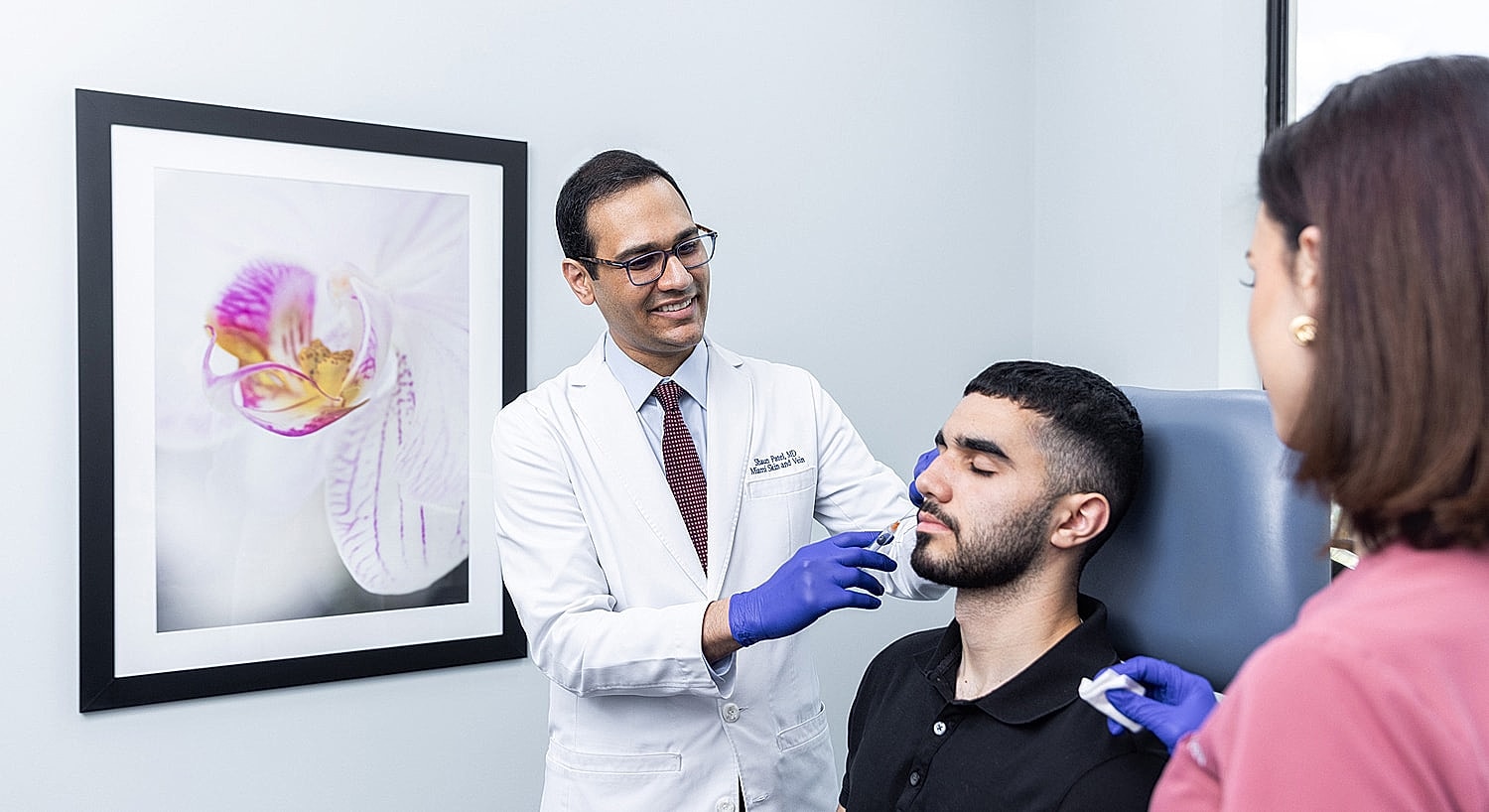
Miami Skin + Vein is physician-led, which matters most where judgment matters most: consultation, anatomy, complication management, and deciding when a patient needs a lighter hand or a different plan altogether.
The goal is not to create a face that performs well online for forty-eight hours. It is to create results that make sense in motion, in daylight, at dinner, at work, and a few months later, when the initial adrenaline has worn off, and the patient is left with reality.
That standard sounds obvious. In this market, it isn’t.
Patients do not need more seduction from their provider. They need accuracy. They need taste. They need someone who can see the difference.
Look for specifics. Specific photos, specific reviews, specific explanations. Trustworthy providers talk clearly about limitations, not just benefits.
No. They can be shaped by lighting, angle, timing, expression, and selection. A more controlled, less dramatic gallery is often the better sign.
Repetitive wording, vague praise, no mention of the actual process, and a tone that feels strangely uniform across many entries.
Because online content is selective by design. Real-life outcomes have to answer to anatomy, healing, movement, skin quality, and time.
Pressure to book quickly, little discussion of risk or downtime, blanket enthusiasm for every treatment, and recommendations that sound more sales-driven than face-specific.
Yes, especially in injectables and more complex cases. It changes the level of assessment, anatomical understanding, and complication readiness.